
Deutsch: Traumpsychologie / Español: Psicología de los sueños / Français: Psychologie des rêves / Italiano: Psicologia dei sogni
Why do we dream? Almost everyone has woken up from a dream and wondered what it meant. Psychology has asked the same question for more than a century, and the answers have changed a great deal along the way. Here is a short tour of the main dream theories in psychology, what the research supports today, and what people actually dream about.
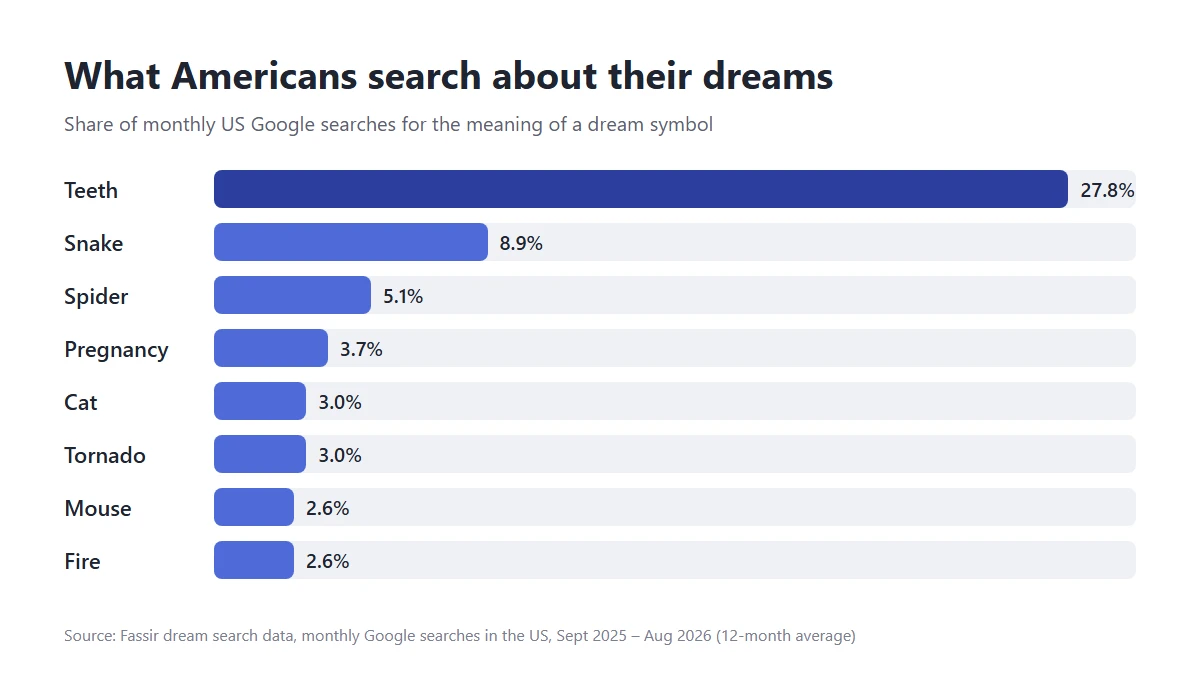
What do people want to understand most? Search data gives a rough answer. In the United States, people run about 243,000 Google searches a month about the meaning of specific dream symbols, according to a 12-month analysis of search volumes by the free dream interpretation site Fassir. One theme dominates: dreams about teeth falling out account for almost 28% of those searches, far ahead of snakes (about 9%), spiders (5%) and pregnancy (4%).
Freud's Dream Theory: Dreams as Disguised Wishes
Sigmund Freud's The Interpretation of Dreams (1899) made dreams a serious subject for psychology. Freud distinguished the manifest content (the story you remember) from the latent content (the hidden wish behind it). In his view, the mind disguises forbidden wishes through processes such as condensation and displacement, so that sleep is not disturbed. Few researchers today accept the theory in its original form, but Freud's lasting contribution was the idea that dreams are meaningful products of the mind rather than noise.
Jung's Dream Theory: Dreams as Compensation
Carl Jung broke with Freud on this point. For Jung, dreams do not hide; they compensate. A dream shows the side of a situation that the conscious mind is ignoring, often in the language of symbols and archetypes such as the Shadow or the Anima. Jung also stressed that a symbol's meaning depends on the dreamer's own associations, which is why two people dreaming of the same snake may need two different readings.
Activation-Synthesis Theory: The Brain Making a Story
In 1977, J. Allan Hobson and Robert McCarley proposed the activation-synthesis hypothesis. During REM sleep, the brainstem sends bursts of activity upward, and the forebrain does what it always does: it tries to make sense of the signals by weaving them into a story. On this view, the bizarre jumps of dream plots come from the biology of REM sleep, not from hidden wishes. Later versions of the model gave more weight to the meaning the brain builds from that activity.
Threat Simulation Theory: Rehearsing Danger
Finnish psychologist Antti Revonsuo suggested in 2000 that dreaming evolved as a threat simulation system: by rehearsing dangerous situations at night, our ancestors were better prepared for them by day. The theory fits a well-known pattern: negative emotions such as fear and anxiety are common in dreams, and chase, falling and attack scenes appear across cultures.
The Continuity Hypothesis and Emotional Processing
Two ideas have strong support in current research. The continuity hypothesis holds that dream content tends to reflect the dreamer's waking concerns, relationships and activities. A related line of work links REM sleep to emotional processing and memory consolidation: sleep appears to help the brain store important memories and soften the emotional charge of difficult experiences. That may explain why stressful periods so often bring vivid, recurring dreams.
Why Do So Many People Dream About Teeth?
The popularity of teeth dreams is a good test case. A Freudian reading would look for a hidden wish; a Jungian reading would ask what the dreamer is neglecting; a continuity reading would look at waking worries about appearance, health, money or how we are seen by others. Researchers have not settled on one explanation, but the sheer volume of searches shows how unsettling these dreams are, and how many people go looking for an answer the next morning, in dream dictionaries and, more and more, in AI dream interpreters such as Fassir.
Interest in dream meaning is not constant through the year either. In the same US data, searches peak in the autumn and are lowest in mid-summer, with October running about 29% above July.
What Dream Theories Mean for You
Modern psychology does not offer a dictionary in which every symbol has one fixed meaning. The most useful approach combines a few questions:
- What was the main feeling? Fear, relief and shame point in different directions.
- What is going on in your life right now? Continuity research suggests the link is often closer than it seems.
- Is the dream recurring? Repeated dreams often track an unresolved concern.
- What does the symbol mean to you? Jung's point still stands: personal associations matter more than generic lists.
Dreams are not predictions, and a frightening dream is not a diagnosis. Persistent nightmares that disturb sleep are worth discussing with a doctor or therapist, since effective treatments such as imagery rehearsal therapy exist.
Understood this way, dreams become less a code to crack and more a mirror: one more way the mind keeps working on what matters to us, even while we sleep.
Similar Terms
- REM sleep: the sleep stage with rapid eye movements, vivid dreaming and high brain activity, which recurs several times each night.
- Manifest content: in Freud's theory, the dream as it is remembered.
- Latent content: in Freud's theory, the hidden wish or meaning behind the remembered dream.
- Compensation: Jung's idea that dreams bring forward what the conscious mind neglects.
- Activation-synthesis hypothesis: the view that dreams arise as the forebrain makes sense of brainstem activity during REM sleep.
- Threat simulation theory: the proposal that dreaming evolved to rehearse responses to danger.
- Continuity hypothesis: the finding that dream content tends to reflect waking concerns and activities.
- Nightmare disorder: frequent, distressing dreams that disturb sleep and daytime functioning.
- Imagery rehearsal therapy: a treatment for recurring nightmares in which the dreamer rewrites the dream and rehearses the new version while awake.
Summary
Psychology's view of dreams has moved from Freud's hidden wishes and Jung's compensation to brain-based and evolutionary models, and today to strong evidence that dreams track waking concerns and help process emotion. No single theory explains every dream. Search data shows what people most want answered, with teeth dreams far ahead of any other theme, and the most useful questions remain personal ones: what you felt, what is happening in your life, and what the symbol means to you.
References
- Freud, S. (1900). The Interpretation of Dreams. Leipzig and Vienna: Franz Deuticke.
- Hobson, J. A., & McCarley, R. W. (1977). The brain as a dream state generator: An activation-synthesis hypothesis of the dream process. American Journal of Psychiatry, 134(12), 1335–1348.
- Jung, C. G. (1960). The Structure and Dynamics of the Psyche (Collected Works, Vol. 8). Princeton University Press.
- Krakow, B., et al. (2001). Imagery rehearsal therapy for chronic nightmares in sexual assault survivors with posttraumatic stress disorder: A randomized controlled trial. JAMA, 286(5), 537–545.
- Revonsuo, A. (2000). The reinterpretation of dreams: An evolutionary hypothesis of the function of dreaming. Behavioral and Brain Sciences, 23(6), 877–901.
- Schredl, M., & Hofmann, F. (2003). Continuity between waking activities and dream activities. Consciousness and Cognition, 12(2), 298–308.
- Walker, M. P., & van der Helm, E. (2009). Overnight therapy? The role of sleep in emotional brain processing. Psychological Bulletin, 135(5), 731–748.